Procedure Post Op Instructions
Below is a list of discharge instruction documents for various procedures. Each document provides important information to help you care for yourself safely after your treatment. Please click on the file name to view or download the instructions related to your procedure.
- Epidural Steroid Injection – ESI Discharge Instructions (08-21-2025)
- Intracept Discharge Instructions (09-02-2025)
- Lumbar Sympathetic Block Discharge Instructions (08-21-2025)
- Medial Branch Block – MBB Discharge Instructions (08-21-2025)
- MILD Discharge Instructions (08-21-2025)
- Radiofrequency Ablation – RFA Discharge Instructions (08-21-2025)
- Sacroiliac Joint Fusion Discharge Instructions (08-21-2025)
- Sacroiliac Joint Injection – SIJ Injection Discharge Instructions (08-21-2025)
- SCS Explant Discharge Instructions (08-21-2025)
- SCS Implant Discharge Instructions (08-21-2025)
- SCS Trial Discharge Instructions (08-21-2025)
- Stellate Ganglion Block – SGB Discharge Instructions (08-21-2025)
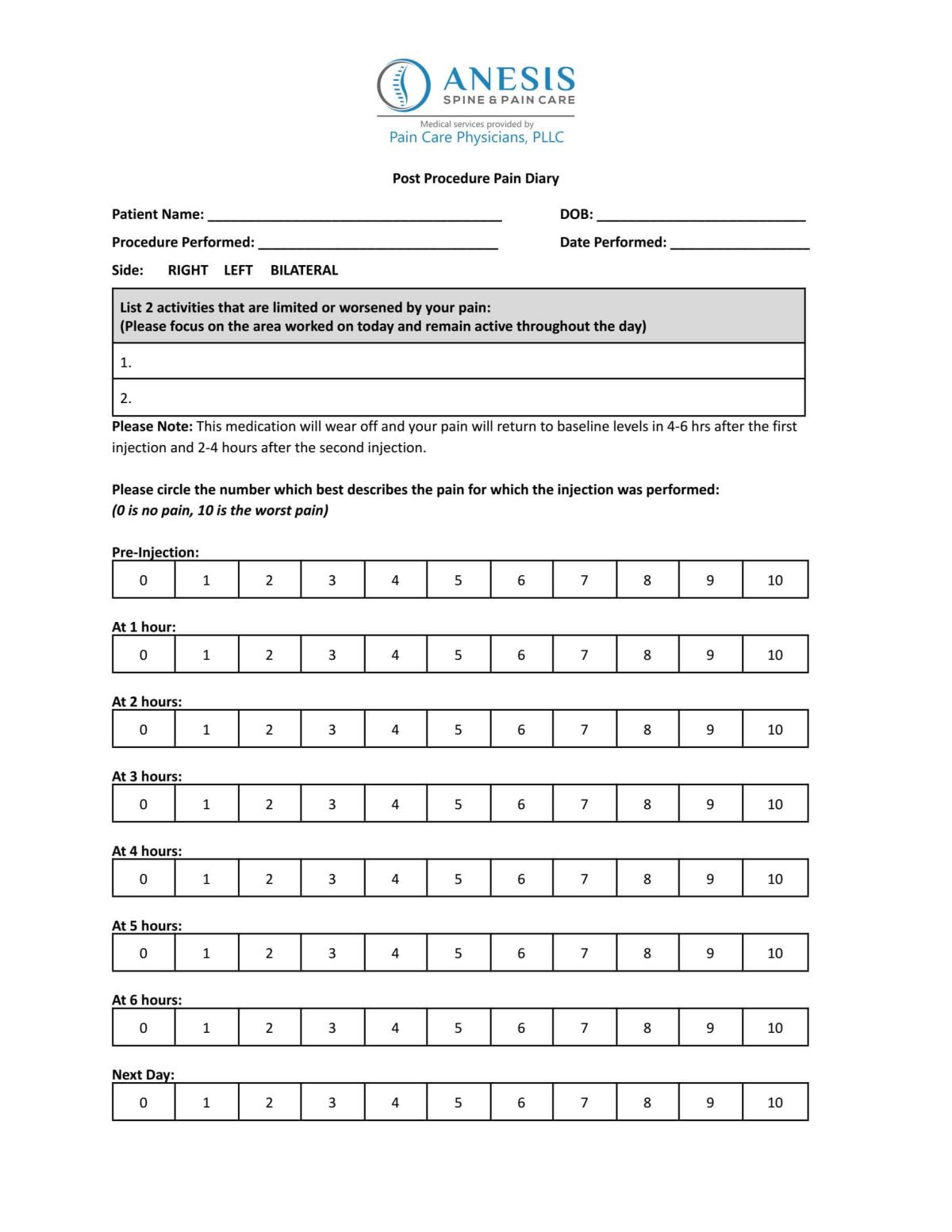
- Post Procedure Pain Diary
Post Operative Instructions
Epidural Steroid Injection
You have received an injection of local anesthetic and corticosteroids. The local anesthetic effects typically last 4–6 hours. It may take 3–7 days to 2 weeks for the corticosteroids to reach optimal effect.
Please pay close attention to the following information/instructions:
- It is common to experience mild soreness at the injection site(s) for 24–48 hours. Ice is the best remedy. You may apply ice for 20 minutes at a time several times a day as needed.
- Avoid heat to the injection area for 72 hours. No hot packs, saunas, or steam rooms during this time. A regular shower is OK. No baths or soaking for 7 days.
- You may immediately restart your regular medication regimen, including pain medications, anti-inflammatory. Blood thinners should be restarted 24 hours post procedure or as discussed with your provider.
- Please remove the sterile dressing/band-aid tonight or tomorrow morning. Do not leave it on after you have taken a shower or gotten it wet.
- Corticosteroid side effects can occur after this injection, but they usually resolve after several days. These side effects can include flushing, hot flashes, mild palpitations, insomnia, water retention, feeling anxious/restless, or headaches.
- While it is extremely rare to get an infection after a spinal procedure, please call the office if you develop any signs of infection. These signs include fevers/chills, severely increased pain, redness at the injection sites, or any drainage from the injection site.
- Remember that the corticosteroid benefit (long-term pain relief) from an injection can take as long as 10 days to occur. You may have a period of slightly increased pain after your injection before the steroid takes effect.
- You may resume all your normal daily activities after your injection immediately.
- It is OK to restart your exercise or physical therapy program as soon as you feel comfortable doing so.
- You should schedule a follow-up visit in 6 weeks to review your response to this injection.
Please contact our office at 206-538-6300 to schedule your follow-up if it has not already been arranged.
Download File: Epidural Steroid Injection – ESI Discharge Instructions 08-21-2025
Post Operative Instructions
Intracept
Your physician performed the Intracept Procedure to help relieve vertebrogenic pain (pain originating in the bones of your spine)
Activity:
- Try to avoid lifting over 10 pounds for 48 hours post-procedure
- Try to avoid extreme bending or twisting of your low back for 48 hours post-procedure
- Day of procedure: do not drive
- Avoid engaging in strenuous activities for 48 hours after the procedure
- Do not abruptly increase activity level or make sudden movement changes
- Avoid twisting movements for the first week
Following the Procedure
- Minimal to moderate activity as tolerated for the next 24 hours, or as directed by physician
- You may resume your regular diet and regular prescriptions/ medicines, including any medications held for this procedure. Anticoagulation 24 hours can be restarted post op unless instructed otherwise.
- Keep the operative site clean and dry until follow up appointment, or as directed by physician. There are no stitches to be removed. Leave outer dressing to cover procedure site until your follow up appointment.
- You may shower after 48 hours. Try to take a “front” shower to avoid drenching your incision site and bandage. Allow water to roll off of you back but do not scrub or rub the incision sites.
- DO NOT soak in a tub, swim in a pool or sit in a hot tub until physician tells you it is safe.
- You may apply an ice pack wrapped in a thin towel to ease the pain around the injection sites. Leave the ice pack in place for 10 minutes every hour, as needed.
- Most patients notice the relief from their chronic pain to take place between 2-12 weeks post- procedure. Full benefits are noticed at 3 months post-op.
- Notify us at 206-538-6300 extension 9883 or 9884 if you have any of the following:
- Increased pain, redness, swelling, or drainage from the injection sites.
- Shortness of breath, difficulty breathing and/ or chest pain.
- Difficulty with walking, changes in sensation (weakness, numbness or tingling) in your hips or legs, new pain, or problems with bowel or bladder functions.
- Fever of 100.4°F or higher or shaking chills.
- Please call physician’s office for any questions or concerns.
- If you feel you have an emergency, go to the nearest emergency room for treatment.
- A follow-up call will be made by a recovery room nurse to check on your progress within a few days.
You should have a follow-up office appointment scheduled 1-2 weeks post-op. If you do not already have an appointment, call to schedule one during regular business hours at 206-538-6300.
Download File: Intracept Discharge Instructions 08-21-2025
Post Operative Instructions
Lumbar Sympathetic Block
- You may experience the sensation of warmth (increased blood flow) in your lower extremity. This is normal.
- Sensation of numbness of the leg is possible and transient.
- Do not drive for 24 hours after injection.
- If you have questions or problems, call the office at (260) 538-630.
Please call our office to schedule an appointment if you don’t already have one or you have questions or problems at (260) 538-6300
Download File: Lumbar Sympathetic Block Discharge Instructions 08-21-2025
Post Operative Instructions
Medial Branch Block
- You have undergone a medial branch block procedure. This procedure is a diagnostic injection to confirm whether the facet joints along the spine are a source of your pain.
- For the next 4–6 hours, the nerves that innervate your facet joints should be numb. During this time, please perform a few activities that normally cause your typical pain symptoms.
- You may experience mild pain or soreness at the site of the injection. You may apply ice packs to the injection site for no longer than 20 minutes at a time. You may remove the bandage over the injection site after approximately 12 hours. You may shower when the bandage is removed. No submerging in water (bathtub, swimming, etc.) for 24 hours after procedure
- Please complete the pain diary that you were given so that we can determine whether you had relief of your typical pain during the 4–6 hours following the procedure. Please bring your pain diary with you to your next doctor’s appointment or have it available for your post-procedure follow-up phone call.
- You should continue medications prior to the procedure except for your pain medications. You should not take your pain medications for 6 hours to accurately diagnose if the facet joints are the source of your pain. Please keep a pain diary rating your pain from 0-10 until you go to bed tonight. You will review your pain diary results with a provider in a few days.
- You may continue with your regular diet.
- You may resume your exercise program. It is important to keep your body moving.
- Per your insurance company’s requirement, your medial branch block will need to be repeated to confirm the results. If the therapeutic procedure is a RFA, we will discuss this option with you in detail based on your specific situation. Please remember your block is only a diagnostic procedure.
- If you are receiving work-up for a peripheral nerve stimulator, the diagnostic procedure will only be performed once.
- In general, if your typical pain is reduced by >80%, then you are a candidate for a radiofrequency ablation or a stimulator. Radiofrequency ablation is a procedure that heats the medial branch nerves that supply the facet joints. By heating the individual nerves to each joint, you have the potential to experience long-term (6 months–12 months) pain relief in these joints. A peripheral nerve stimulator is an implantable device that provides indefinite and permanent pain relief.
Please contact our office at 206-538-6300 to schedule your follow-up if it has not already been arranged.
Download File: Medial Branch Block – MBB Discharge Instructions 08-21-2025
mild® Post-Procedure Care
To achieve optimal recovery and results, follow these instructions carefully.
What to Expect After the mild® Procedure
- You should be discharged and able to walk on the same day of the procedure.
- As with any procedure, you may feel sore afterwards. If you feel extreme pain and/or weakness, contact your physician immediately.
Medication
- Tell your physician about any prescribed or over-the-counter medications you are currently taking.
- Continue taking them as directed by your physician(s).
- If you feel soreness or minor discomfort, you may take Tylenol and/or NSAID (Ibuprofen).
Activity Restrictions & Resumption
- Resume normal activity within 24 hours with no restrictions. Walking is the best exercise, and daily walking is strongly recommended to begin reconditioning your body.
- Gradually increase the length and distance of your walks. Start inside your home, then progress out and around your home, as tolerated, and progress to your neighborhood or shopping center.
- Avoid strenuous exercise and heavy lifting for 1 week.
- Try to limit long car rides (greater than 1 hour) for a few weeks, or as tolerated.
- Do not drive while on pain medications.
Incision Care
- Remove the outer dressings 5 days after the procedure.
- Adhesive strips will cover the incision(s) and should begin to fall off within 7–10 days after the procedure. If they have not fallen off after 14 days, you may remove them.
- You may begin to shower 7 days after the procedure.
- Do not sit in the bath. (no soaking)
- Do not rub the incision.
- Do not apply lotion, medication, or cream to the incision.
Post-Procedure Office Visits
- Follow-up appointments will be conducted at 7-14 days post-procedure.
- If your follow-up appointments have not been scheduled, please contact our office at 206-538-6300 within 24 hours after your procedure to schedule your appointments.
Warning Signs
- Contact your physician immediately, at 206-538-6300, if you experience any of the following:
- Constant bleeding from the incision that will not stop after applying direct pressure for 10 minutes.
- Swelling, redness, or a change in drainage at incision site (such as an increase in amount of fluid, a foul odor, or a change in color).
- A change in mental status, such as unusual behavior, confusion, or difficulty standing or walking.
- A temperature greater than 101 degrees Fahrenheit.
Please call our office to schedule an appointment if you don’t already have one or you have questions or problems at (260) 538-6300.
Download File: MILD discharge instructions 08-21-2025
Post Operative Instructions
Radiofrequency Ablation (RFA)
Activity:
- Rest for the remainder of the day and as needed, it is normal to feel flu-like symptoms/general body aches for a few days.
- If you were given sedation/anesthesia or pain medication: do not drive, operate heavy equipment/machinery, or make any important decisions for 24 hours.
Diet:
- You may resume your usual diet.
- Drink plenty of fluids.
Medications:
- You may take your usual pain medication (per label instructions) if you have any discomfort.
- Any additional pain should be treated with Tylenol and/or NSAIDS.
Procedure Site Care:
- You may remove the Band-Aid or dressing after the first 24 hours and take a shower.
- No bathing/soaking for 48 hours.
Seek immediate medical attention for:
- Redness, tenderness, swelling, or drainage from the procedure site.
- Excessive bright red blood draining from the procedure site (apply pressure).
- Increased pain not relieved by over the counter or prescribed medication.
- Chills or temperature above 101 degrees.
- Dizziness, numbness or tingling.
- Difficulty breathing.
Please contact our office at 206-538-6300 to schedule your follow-up after 6 weeks post procedure, if it has not already been arranged, or for any concerns.
Download File: Radiofrequency Ablation – RFA Discharge Instructions 08-21-2025
Post Op Activity Instructions
SI Joint Fusion
Activity
Being up and about to care for personal needs is permissible but avoid strenuous activity. Do not put yourself in a position to fall. Going up and down stairs is OK but use handrails and take one step at a time until comfortable.
Take precautions and use assistance if unsure such as a cane or walker.
Avoid sitting for longer than 45 minutes to one hour at a time. Sitting for longer periods of time adds to discomfort. Take a 10 minute break to get up and move around or lie down before sitting again.
Avoid NSAIDs such as aspirin and ibuprofen and steroids for 6 weeks after surgery to allow healing and bone fusion.
Exercise
Walking is the best exercise after surgery and please walk DAILY. Don’t engage in any other activity until instructed by your surgeon. Gradually increase the walking distance and if weather permits walking outside is OK.
Gradually increase the distance you walk until you can walk about one mile within one to two months after surgery.
Avoid high heels for the first month after surgery
Bathing
Showering and getting the incision wet is permissible after your post-op appointment once cleared by the surgeon.
Avoid scrubbing the incision site.
Do not soak the incision so avoid baths, hot tubs or swimming for 1 month.
Normal for the incision to itch but avoid scratching.
Driving
Driving is permissible once cleared by your surgeon at your post-op unit. Riding in an automobile is OK as tolerated.
Smoking
You should not smoke after surgery. Smoking decreases the rate of skin and bone healing and interferes with the effectiveness of your pain medication. Contact your primary care physician for smoking cessation options prior to surgery if needed.
For Pain:
Take pain medications as prescribed. It is normal to have additional pain after surgery and acute pain should get better within the first week post op. Expect subacute discomfort for 2-4 weeks post op.
2-4 weeks Post Op
If you are already taking opioid pain medications, you can expect to experience more intense post op pain.
Office Follow up
You will need a post-operative appointment for an incision check at 7-10 days after surgery. You will also be seen 3 months after surgery.
Please call our office to schedule an appointment if you don’t already have one or you have questions or problems at (260) 538-6300
Download File: Sacroiliac Joint Fusion Discharge Instructions 08-21-2025
Post Operative Instructions
Sacroiliac (SI) Joint Injection
It is common to experience mild soreness at the injection site(s) for 24–48 hours. Ice is the best remedy. You may apply ice for 20 minutes at a time, several times a day, as needed.
Avoid heat to the injection area for 72 hours. No hot packs, saunas, or steam rooms during this time. A regular shower is OK.
You may immediately restart your regular medication regimen, including pain medications, anti-inflammatories, and blood thinners. (No need for these to be held).
Please remove the sterile dressing or band-aid tonight or tomorrow morning. Do not leave it on after you have taken a shower or gotten it wet.
Corticosteroid side effects can occur after this injection but usually resolve after several days. These side effects can include flushing, hot flashes, mild palpitations, insomnia, water retention, feeling anxious or restless, or headaches.
While it is extremely rare to get an infection after joint injections, if you develop any signs of infection, please call the office at 206-538-6300. These signs include fevers or chills, severe increased pain, redness at the injection site, or any drainage from the injection site.
Remember that the corticosteroid benefit (long-term pain relief) from an injection can take as long as 10 days to occur. You may have a period of slightly increased pain after your injection before the steroid takes effect.
You may resume all your normal daily activities immediately after your injection.
It is OK to restart your exercise or Physical Therapy program as soon as you feel comfortable doing so.
Please contact our office at 206-538-6300 to schedule your follow-up if it has not already been arranged.
Download File: Sacroiliac Joint Injection – SIJ Injection Discharge Instructions 08-21-2025
Post Operative Instructions
SCS Explant
Do not submerge the incision in water until the incision site is fully healed, meaning no: Swimming pools, bathtubs, hot tubs, etc.
Ok to shower, but do not get your incision wet for 5 days after your procedure.
You may remove your outer dressing 24-48 hours after the procedure. If there are adhesive strips “steri-strips” over the incision, leave them in place; they will come off on their own over time.
Make sure you fill and take any medications if prescribed.
Call your physician if:
- You notice any unexpected bleeding, or redness, swelling, or drainage from your incision
- You have a fever of 100 degrees or above
- You notice anything unusual or unexpected that concerns you
You may experience mild discomfort at the site for several days.
Download File: SCS Explant Discharge Instructions 08-21-2025
Post Operative Instructions
Spinal Cord Stimulator / DRG / Nalu (PNS) Implant
You are about to return home with a Spinal Cord Stimulation System (SCS) in place. SCS works by delivering small electrical pulses to the spinal cord which block the sensation of pain. Instead of pain, you may experience a tingling sensation in these areas of your body.
- After the procedure:
- Avoid getting your dressing wet or removing it until your follow up appointment when the stitches and/or staples will likely be removed. This is typically 10-14 days after your surgery. No showering until staple removed, no submerging in water for 6 weeks
- You may continue your normal medications, unless directed otherwise by your physician. You should have received post-op opioid medications.
- If an antibiotic is provided, please pick it up from your preferred pharmacy and take it as directed.
- You MAY experience a tingling sensation over the area of your pain following surgery. This depends on the type of SCS you had implanted.
- The tingling sensation may increase when you lean back, bend your neck back, sit or lie down.
- The tingling sensation may decrease when you stand up.
- The tingling sensation may appear to stop when you bend your neck forward or lean forward.
- For the next six (6) to eight (8) weeks:
- DO NOT
- Sleep on your stomach.
- Put your arms over your head to reach
- Bend, twist or stretch at the waist
- Lift or pull more than ten pounds.
- Submerge in water for 6 weeks post op
- Have any steroid injections or dental procedures for 6 weeks after implantation
- DO
- Sleep with a firm mattress which equally supports your legs and back.
- Take sponge baths to avoid submerging and getting the incision wet until the stitches/staples are removed.
- Take short walks.
- Follow your physician’s recommendations regarding sexual activity.
- Move your body without twisting your shoulders and hips.
- Avoid abrupt movements.
- A follow up appointment will be scheduled for you before being discharged if you don’t already have one. Follow your physician’s instructions regarding when to return to work.
- Follow any additional instructions provided by the SCS company representative. Any question regarding the operation of the SCS system, failure of therapy <50% relief, and/or other technical or operational issues should be addressed with the representative and not the surgeon.
SPECIFIC PROBLEMS TO WATCH FOR AND REPORT TO YOUR PAIN MANAGEMENT DOCTOR
- Temperature over 101 degrees Fahrenheit.
- New or different numbness, tingling, and/or weakness.
- Increased redness and swelling at surgical sites.
- Persistent headache not relieved with pain medication.
- Opening of the wound.
- Chills.
- Loss of control of urine or stool
If you have questions or problems, call the office at (260) 538-6300 and communicate concerns with the device rep.
Download File: SCS Implant Discharge Instructions 08-25-2025
Post Operative Instructions
Spinal Cord Stimulator Trial
DRG / NALU (PNS)
Resume your pre-procedure level of activity to allow your physician to best evaluate the effectiveness of the device.
ALWAYS have the trial stimulator unit in hand or attached to your belt whenever you are walking.
Avoid activities that require lifting more than 10 pounds, bending at the waist, twisting, pulling, reaching overhead. Avoid strenuous activities as this may dislodge the stimulator lead. The use of slip-on shoes is suggested to avoid having to bend to tie shoes.
DO NOT drive or operate machinery for 24 hours after the sedation.
HYGIENE
YOU MUST KEEP THE SURGICAL DRESSING CLEAN AND DRY
- No tub bathing or soaking in water
- No showering. Sponge bathing permitted with attention not to wet dressing.
- DIET – Resume your regular diet as tolerated.
MEDICATION – You may resume all your preoperative medications (see exceptions below) unless otherwise instructed. **Aspirin, aspirin containing products, non-steroidal anti-inflammatory drugs, Xarelto, Eliquis, Brillinta, antiplatelet drugs (Plavix, Ticlid, Aggrenox and anticoagulant drugs (Coumadin, Heparin) should NOT be resumed until 24 hours after the stimulator lead is removed, unless you have been otherwise instructed.
PAIN – Soreness at the lead insertion site in your back is to be expected. Resume your previously prescribed pain medications.
Please call the office if you experience any of the following: fever (> 101.4 F oral), chills; severe back pain, drainage, redness, swelling at the procedure site; prolonged dizziness/lightheadedness (longer than 24 hours).
If you develop new weakness in your legs or arms and/or difficulty walking that is worsening, this may be a sign of a very serious complication that requires emergency treatment. Please proceed to the nearest emergency room without delay.
For any medical emergency please call 911 or proceed to the nearest emergency room.
If you have questions or problems, call the office at (260) 538-6300 and communicate concerns with the device rep.
Please contact our office to schedule your follow-up if it has not already been arranged.
Download File: SCS Trial Discharge Instructions 08-21-2025
Post Operative Instructions
Stellate Ganglion Block/ Lumbar Sympathetic
You may experience sore throat, hoarse voice, and/or droopy eyelid on side of injection. Start with small sips of fluids when you can swallow without problems and advance slowly to a regular diet. If you had a stellate ganglion block or sympathetic block you can resume exercise at once.
General Post-Procedure Instructions: Icing the area of injection for 20 minutes at a time, 3 times a day for the first 1 to 2 days following the procedure will reduce local soreness.
On the second or third day, the heat may feel better. Use ice and heat with caution if the skin is numb.
NOTIFY PHYSICIAN IF YOU HAVE NOT VOIDED WITHIN SIX HOURS.
What to expect from your procedure: You may experience any of the following symptoms: Drowsiness, nausea, muscle soreness, muscle spasm, and/or increasing pain.
CALL PHYSICIAN IMMEDIATELY ( 206-538-6300 ) FOR: fever over 101° or skin rash, uncontrolled nausea, redness around the injection site, severe pain, numbness or tingling lasting longer than 24 hours.
GO TO THE NEAREST EMERGENCY IF YOU ARE UNABLE TO CONTACT YOUR DOCTOR IN AN EMERGENCY, CALL 911 OR GO TO THE ER.
Please contact our office at 206-538-6300 to schedule your follow-up if it has not already been arranged.
Download File: Stellate Ganglion Block – SGB Discharge Instructions 08-21-2025